



Craftsman use tools to build and create, but what are the fundamentals you can use to help your students build skills and a lifelong relationship with music in your classroom? The West Music Education Consultants are here to help with instruments, curriculum, and accessories for any grade level and budget. Read below for Sam’s ukulele suggestions, Jessica’s ideas for recorder success, Judy’s picks for your Orff instrument program, and Tereasa’s must-haves in drums and percussion. Ready to shop now? Check out our complete selection of Classroom Building Blocks products!
Ukuleles
Education Consultant Sam Marchuk is here to help you create a successful ukulele program for your students! Read about Sam’s suggestions here and shop our collection of Ukulele building blocks here!
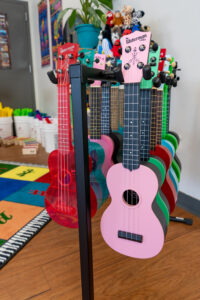 Planning an effective classroom ukulele program requires the consideration of several factors; consider the following when starting your ukulele venture.
Student Ukuleles will be the core of your ukulele program. There are 4 sizes of ukuleles to investigate: soprano, concert, tenor, and baritone. Soprano, concert, and tenor ukuleles are in the same voice and tuning, with baritone ukuleles standing alone. The soprano size is the most common due to price, size, and ease of storage. If budget allows, we recommend considering your students’ advancement potential with concert ukuleles.
Teacher Ukuleles are often the same size as their students’, but many teachers prefer the concert or tenor size. The larger instruments are easier for demonstration, provide a fuller and deeper tone, project more volume, and the larger fret board may be more comfortable for adults. With only a nominal increase in price increase, using a larger ukulele for accompaniment in classroom may enhance and encourage student players. For the more advanced player, upgraded features can improve tone, be more aesthetically appealing, and amplify volume.
Ukulele Curriculum & Supplements are teaching game changers. What approach will you use in teaching your students how to play ukuleles? From pedagogical methods that dig into technique, skill, scales, etc., to supplemental materials that include arrangements and activities for incorporating other classroom instruments and movement, to song collections – we’ve got you covered with our extensive collection and expert consultants.
Ukulele Storage & Accessories are indispensable in keeping your ukulele program in tip-top shape. While some ukuleles include a tote or bag, you’ll need to plan for the full collection when adding ukulele to your classroom. Be sure to make accommodations for storage, accessibility, tuners, strings, and stands.l genres and collaboration opportunities students will love.
Orff Instruments
Education Consultant Judy Pine is here to help you create a successful Orff-Schulwerk program for your students! Read about Judy’s suggestions here and shop our collection of Orff instrument & accessories building blocks here!
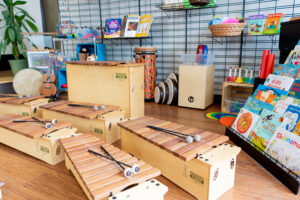 Whether you can start with one barred Orff instrument or a set of 15, here are some guidelines to consider.
Start with Xylophones first as they are the heart of your ensemble. The goal is to have 3 or 4 times the number of xylophones compared to metals. One alto or bass xylophone can be your beginning, then add Glockenspiels and Metallophones to build from there. Look at your budget, class size, and space, and consider enough instruments for 1/2-1/4 of your students to use simultaneously with other un-pitched instruments.
Bass Bars add a real foundation to your ensemble. Low C, F, and G are common bars, but consider that D, F, and A may suit your students’ vocal ranges better. Mallets are provided with xylophones, metallophones, and glockenspiels, but not with bass bars. Purchase extra mallets early to make sharing instruments easier. We recommend you use soft mallets for basses, medium-hard for altos, and hard for soprano xylophones. And don’t forget Orff Stands to raise, storage/carrying bags to protect, and Repair Parts for the unexpected.
Orff Curriculums & Supplements come in a wide variety of resources filled with materials for the K-8 general music classroom.
Drums & Percussion
Education Consultant Tereasa Evans is here to help you create a successful drums & percussion program for your students! Read about Tereasa’s suggestions here and shop our collection of drums & percussion building blocks here!
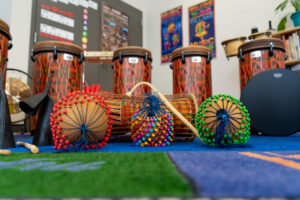 Drums, shakers, scrapers, metals, woods, and sound effects galore! The world of unpitched percussion is at the center of a student-based, meaningful music program because it allows students to explore their creativity and join in active music making. When choosing instruments, remember three Bs: BALANCE, BUDGET, and BOUNTIFUL.
Balancing and blending instruments together is important to general music education classrooms just like it is with any ensemble. With the right selection of Shakers, Scrapers, Metals, Drums, and Woods in the hands of your players, your classroom will be the most joyful room in the building! Consider the type of music, your objectives, and/or curriculum. 30 cowbells playing the timeline for Ensemble I of the World Music Drumming Curriculum would be slightly overzealous, but you might want 30 cowbells for a performance of Click, Clack, Moo! Cows That Type!
Budget-conscious decisions are important when considering the quality and construction of instruments. You can stretch your budget dollars by choosing instruments that are known for their durability, quality, and sound. Remo Key-Tuned Tubanos are a staple of most music classrooms. They were designed specifically for music educators, and can be disinfected, are highly durable, and kids absolutely love them! Do you need a tubano for every student? Possibly, but you want to ensure you’re looking at the overall picture of how your classroom makes music together.
Giving your students a bountiful selection of unpitched percussion will enhance their creativity. Teach them how to use them, step back and watch them explore on their own. Want a good laugh or an attention grabber? Try shaking the West Music Canary or Quack Sticks, and the funny sound will turn a blue day brighter! Need a soothing sound that mimics the ocean? Try the Remo 16” Fish Graphic Ocean Drum! Choose a variety of sound effects and make it fun!
Recorders
Education Consultant Jessica Palmer is here to help you create a successful recorder program for your students! Read about Jessica’s suggestions here and shop our collection of recorder building blocks here!
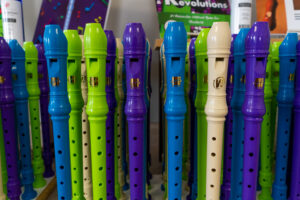 Whether you are upgrading your recorder program or building one from scratch, you’ll want to consider instruments, accessories, curriculum, and ensemble music.
Recorder Instruments come in a variety of colors and brands, but there are a few things to consider when choosing the type of recorder to use for your program. If you want students to be able to fine-tune their recorders, consider a 3-piece recorder over a 1-piece. All of our recorders are classroom tested and teacher-approved!
Storage & Accessories will help keep your instruments in good shape and more accessible for players. Fabric bags allow recorders to dry out between sessions. A neck strap or thumb rest can provide the support for students to be successful in their playing.
Curriculum will help guide your program, and you have lots of choices. From traditional method books to interactive whiteboards resources, look for a resource that will work with the goals of your program. Decide if students will need their own books or if you will use a teacher edition alone.
Ensembles will take your recorder students to the next level. Consider adding sopranino, alto, tenor, and bass recorders to your program. Adding multiple instruments to your classroom will open up a variety of musical genres and collaboration opportunities students will love.
Find even more resources and hand-selected products for your classroom in the West Music 2021-22 catalog.









I introduced ukes to my 4-5 year olds but tuned them to the C pentatonic scale so they could strum, sing and rock out without learning how to fret–added drums and resonator bells and they named themselves The Stars Band. Never had so much fun!